
Most people don’t realize the profound impact that friction and wear have on daily life. Nearly 20% of the world's total energy consumption is lost to friction, and over 20% of pollutants in the air result from mechanical inefficiencies. For decades, industries have relied on synthetic lubricants and greases to mitigate these losses. However, these solutions are temporary, requiring frequent reapplication and often introducing toxic, long-lasting chemicals into the environment.
At Duravi, we believe there’s a better way.
Our proprietary technology goes further by measurably modifying the metal surface itself, increasing smoothness and hardness while refining near-surface grain structure.
OUR TECHNOLOGY
ViSUAL evidence
Independent Laboratory Analysis
An independent study by RTI compared metal surfaces treated with Duravi and Mobil 1 lubricants using advanced testing methods — including SEM, EDS, FTIR, metallography, and microhardness analysis.

RTI Labs: Wear Depth Comparison on a Bearing Test
Wear demonstrated at 15 pounds of pressure for a leading synthetic oil vs. Duravi
Leading Synthetic Oil
The results were clear:
Microscopic imaging showed that Duravi-treated metal had a significantly smaller wear zone than the surface treated with Mobil 1.
In other words, Duravi provided stronger surface protection and less material degradation under identical conditions.

Treated with Duravi
METAL SURFACE ENGINEERING
Duravi technology produces measurable changes in metal surface morphology and microstructure. Testing has demonstrated smoother surfaces, increased hardness, and substantial refinement of near-surface grain structure under operating conditions.
Vibrational evidence
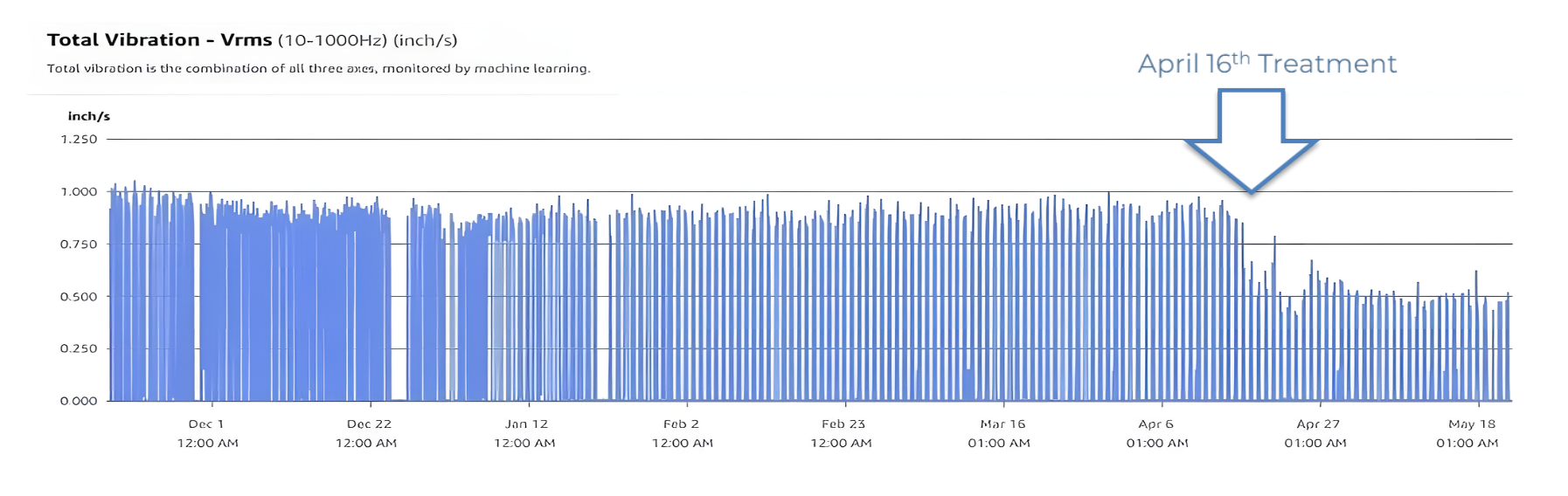
Vibration Reduction in Amazon Distribution Center Gear Box
Gear box hydraulic system was overheating causing component failure every three months. Before Duravi Treatment, vibration averaged nearly 1.0 in/s (very high). After Duravi Treatment, vibration dropped nearly 50%, and over time stabilizing below 0.5 in/s.
DEMO
Experience the power of Duravi Catalyst in action. Watch as our demonstration on steel highlights its ability to transform metal surfaces, reduce friction, and enhance durability like never before.
Hardening Evidence
Treating metal with Duravi increases the metal’s hardness without sacrificing flexibility or increasing brittleness.

